The ND FFA Foundation is proud to support educational experiences that connect students to agriculture in meaningful, hands-on ways. In partnership with the North Dakota Department of Agriculture, the Ag in the Classroom grant program helps schools bring agricultural concepts to life through innovative classroom projects. One such project introduced middle school students to soil-free farming—and some tasty results.
Program: Ward County Extension Facilitator: Emily How, Ward County Extension Impact: 166 students
Purpose: Introduce students to the science and practicality of hydroponics, while encouraging them to explore where their food comes from and how it can be grown in alternative environments.
Objectives:
Build a self-sustaining hydroponic system to grow lettuce indoors.
Understand plant needs, capillary action, and root development.
Practice testing and monitoring pH and nutrient levels for optimal plant growth.
Track growth using garden journals with drawings and plant observations.
Learn about food miles and the benefits of local food production.
Share learning with younger students and the broader school community.
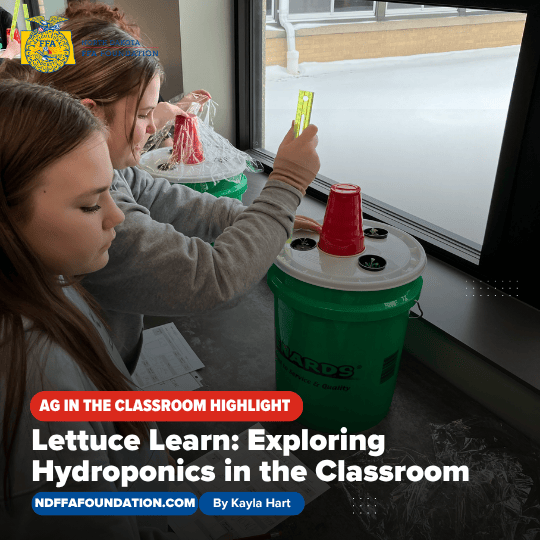
Students monitor lettuce growth indoors using hydroponic setups in a hallway display.
With supplies purchased through the grant—including grow lights and materials to build hydroponic systems—students designed and monitored small-scale systems to grow lettuce. These systems were placed in common areas of the school, sparking curiosity and conversation among students and staff alike. Diagrams were posted to explain the process and science behind hydroponics.
While a full harvest wasn’t achieved within the program timeline, the impact was undeniable. Students gained valuable insight into plant science and sustainable growing methods. Some of their reflections included:
“I liked that I got to monitor plant growth indoors, because I do love plants, and it’s interesting.” – Ava, 8th Grade “I learned that lettuce grows faster than you think.” – Nellie, 5th Grade “I learned that it takes longer when plants don’t have enough light.” – Emma, 5th Grade “I learned that I can plant food in my yard.” – Carsen, 5th Grade
Teachers noted that the project brought enthusiasm and cross-curricular connections, and several are already planning for next year. The interest from younger students was especially strong—planting the seeds for future engagement in agriculture.