The ND FFA Foundation is committed to enhancing agricultural literacy through real-life, impactful learning experiences. The Ag in the Classroom grant is offered through the partnership with the North Dakota Department of Agriculture, providing funds for creative educators who help students explore where their food comes from and the people behind it. This year’s project in Rugby offered an immersive look into the dairy industry, combining classroom learning with food science and real-world farm visits.
Program: Ely Elementary Teacher: Kristen Heilman, 4th grade teacher at Ely Elementary Impact: 20 students Purpose: To educate students about the dairy industry and help them understand the journey of dairy products from farm to table.
Objectives:
Teach students how dairy products are made and processed.
Offer hands-on learning using tools such as ice cream and yogurt makers.
Introduce real-world agricultural careers and farming systems through field trips.
Inspire curiosity and strengthen reasoning skills through exploration and inquiry.
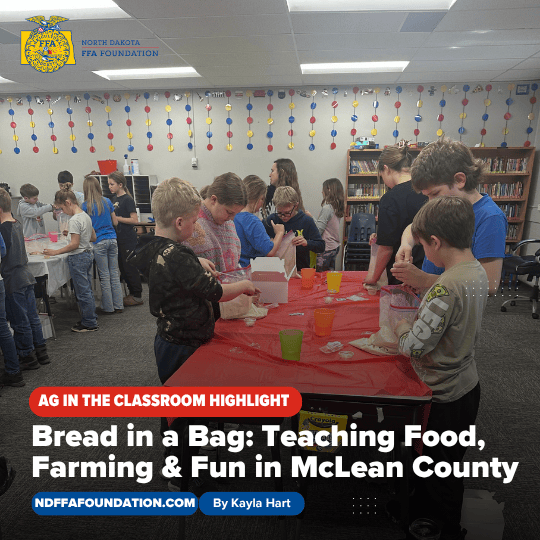
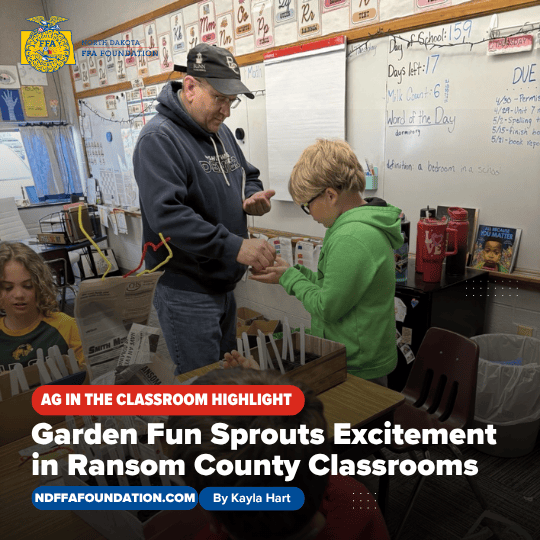
Throughout the school year, students participated in weekly mini-lessons on various agriculture topics, with this year’s spotlight focused on dairy. Using grant funds, the classroom was stocked with engaging children’s books that covered everything from milking to cheese-making. The unit came to life in December when guest presenter Moriah Aviso from Souris taught students how to make butter, yogurt, mozzarella, and ice cream from scratch.
The students also sampled donated cheeses from The Cheesery and learned how cream separates from milk, how whipped cream forms, and how cold water is key in the butter-making process. During this dairy lab, students created five different dairy products from a single ingredient—milk: cream, whipped cream, buttermilk, and butter.
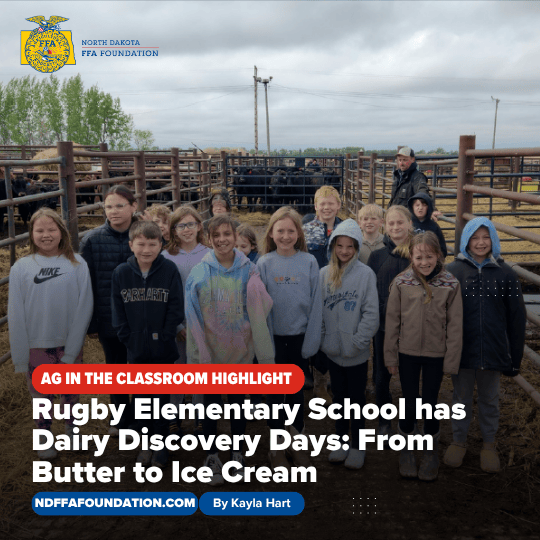
To tie everything together, students took two impactful field trips. At Pay-Dak Dairy near Towner, students had the opportunity to milk cows, bottle-feed calves, observe feeding with a self-propelled “milk taxi,” and learn about the daily operations of a working dairy.
One of the students’ favorite parts was watching the milk taxi in action. The milk taxi is an automated system that warms, dispenses, and transports milk to feed calves efficiently.
Their second trip was to a local cattle auction, where many had never been before. Students observed live cattle sales, interacted with a yard staff, and asked questions about the cattle market, transportation, and how livestock is valued. They learned how the auctioneer’s role works, what a livestock scale does, and why certain animals sell for more or less. And of course, no trip to the sale barn was complete without a milkshake from the café, making it a well-rounded (and delicious) experience.
Student Reflections: “We’re going to try making yogurt at home with my mom!” “I didn’t know whipped cream came before butter!”
To measure learning, students completed a pre- and post-test with 31 questions. Mrs.Heilman observed that students showed the most growth in areas where they had firsthand experiences, reinforcing the value of active learning. From making food to meeting farmers, this project connected students to agriculture in meaningful, memorable ways.